Political history · Guide 2026
Understand the Paris Commune in Montmartre
On 18 March 1871, an attempt to recover National Guard cannon on the heights of Paris sparked an uprising. The Commune was proclaimed on 28 March and ended during the Bloody Week in May. Almost nothing on the hill now tells that story directly: this guide connects a few documented streets with archival sources without treating today’s landscape as a surviving scene from 1871.
The short answer
What matters before you go.
To understand Montmartre’s role, begin on the hill where National Guard cannon were positioned, pass the corner of rues de la Bonne and du Chevalier-de-la-Barre, then descend rue Lepic to place Blanche. The Paris Archives explain the political and social causes, while the City documents these places. This is not a trail of preserved Commune monuments.
Action plan
The route,
step by step.
Times and order are guideposts. Always adapt the visit to crowds, actual access and your group’s energy.
Place the cannon on the hill
The heights of Montmartre and Belleville held National Guard cannon. The government troops’ attempt to recover them at dawn on 18 March immediately triggered the uprising. Look at the terrain before searching for a plaque: it explains the site’s strategic value.
Rues de la Bonne and du Chevalier-de-la-Barre
The City locates the execution of generals Lecomte and Thomas at this corner on 18 March. The violence makes clear that the day cannot be reduced to celebration or heroic imagery. The former rue des Rosiers was renamed; use dated sources to connect historic and present-day street names.
Descend rue Lepic
Now lined with shops, rue Lepic is among the streets where the City records barricades in 1871. Do not assume a present-day façade witnessed the fighting; instead notice the slope, junctions and links with neighbouring streets.
Finish at place Blanche
Place Blanche also appears in records of barricades. It is a useful place to remember that the Commune extended far beyond Montmartre: other parts of Paris saw fighting, political debate and bloody repression. Continue with the Paris Archives’ documents.
Understand more · choose well
Dates that help explain the façades.
History becomes clearer when the former village, the growth of Paris and the construction of monuments are kept distinct. These dated landmarks put what you see in context without reducing the hill to a single legend.
1860: a change of territory
The Paris Archives list Montmartre among the communes annexed in 1860. Compare old plans with present addresses to understand the streets: a neighbourhood name, a former commune and an arrondissement do not describe exactly the same territory.
Archives de Paris — communes annexées ↗1875 and 1919: two distinct moments
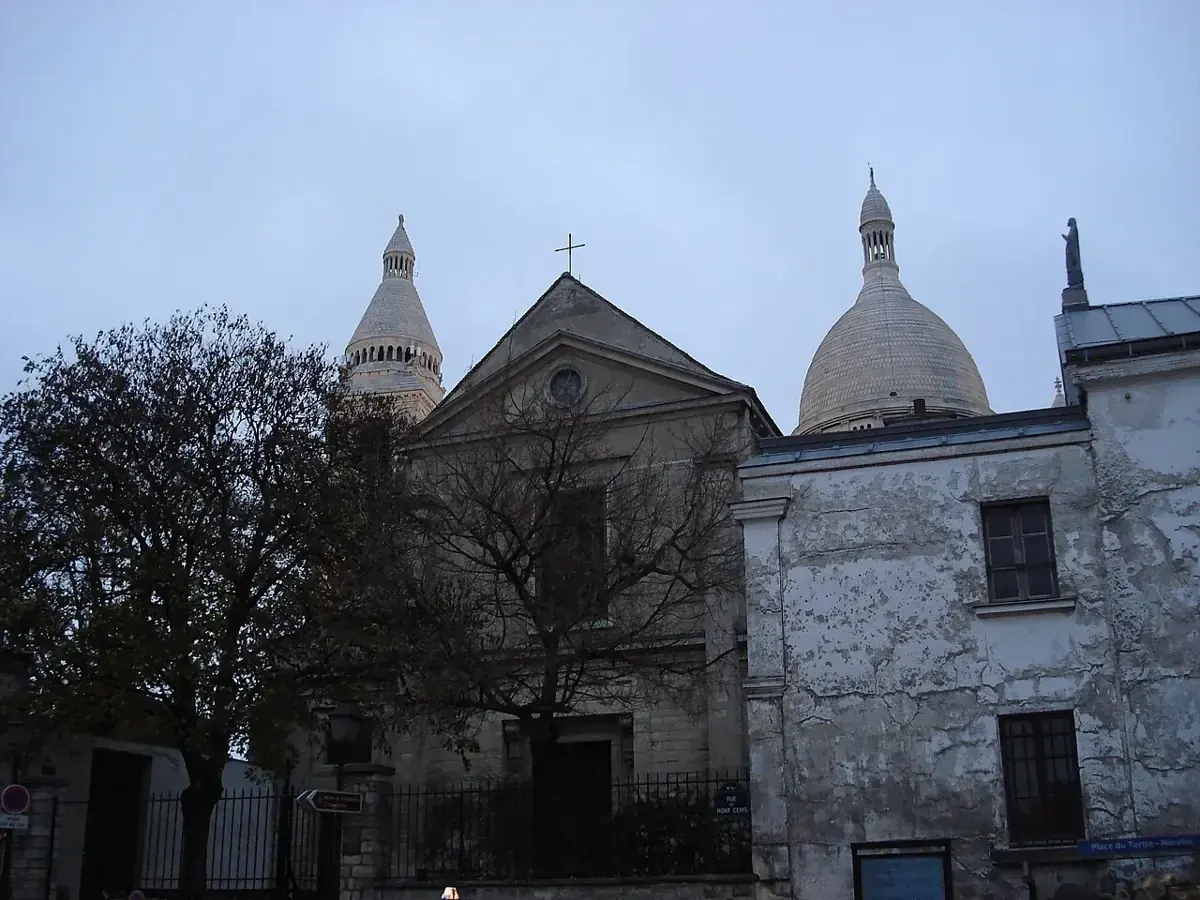
The sanctuary dates the laying of Sacré-Cœur’s foundation stone to 1875 and its consecration to 16 October 1919. Paul Abadie’s Romano-Byzantine design explains the domes: despite its silhouette, this is not a medieval church.
Sacré-Cœur — our history ↗A photograph, a period
Eugène Atget’s view of rue de la Bonne, dated between 1900 and 1901 on Commons, is held by the BnF. Compare building volumes, walls and perspective rather than expecting a perfectly matching before-and-after view: framing and street level may differ.
Eugène Atget — notice Commons / collection BnF ↗- 1860Montmartre annexed to Paris
- 1875Sacré-Cœur foundation stone
- 1919Basilica consecration
- 1934First harvest of the replanted vineyard
Sources: Paris Archives, the sanctuary’s history and the City’s vineyard listing. Dates mark separate events, not continuous construction. Harvest source ↗
Useful trade-offs
What really changes the visit.
Compare sources
The City identifies sites; the Archives trace the crisis of 1870–1871. Date historic images and captions before drawing conclusions from them.
Avoid shortcuts
The Commune did not arise from the cannon episode alone. The siege of Paris, defeat by Prussia, government decisions and social tensions also shaped 18 March.
Read Sacré-Cœur carefully
The basilica project followed the uprising and its political meaning was debated from the start. Treat interpretations as historical debate rather than giving the building one single explanation.
Practical questions
Before confirming the route.
What happened in Montmartre on 18 March 1871?+
Troops sent to recover National Guard cannon on the heights met opposition from residents and guards. The day sparked a Parisian uprising; the Commune was proclaimed ten days later.
Can the barricades still be seen?+
No. Sources identify locations including place Blanche and rue Lepic, but the structures of 1871 do not survive there. This walk reads history through today’s streets.
Was Sacré-Cœur built during the Commune?+
No. The project and construction came later. Its symbolic relationship with the Commune has been contested, as the City of Paris describes in its historical account.
Check on the day
Official and practical sources.
Hours, outages, works, prices and access conditions change. For any important requirement, check the relevant source and contact the venue directly.